
Press & brand kit
Understanding a brand’s place in AI answers.
Omni Impact helps brands and agencies understand how they appear in AI answers, inspect the supporting sources, and turn findings into website and content improvements.
Media edition · October 14, 2026
Company-supplied facts. Dated sources. Illustrative visuals clearly identified.
- Category
- Answer engine optimizationAEO & AI visibility
- Company
- Rochester, New YorkFounded by Ben Fowler and Adam Quarterman
- For
- Brands & agenciesSubscription software + free diagnostic
From observation to action.
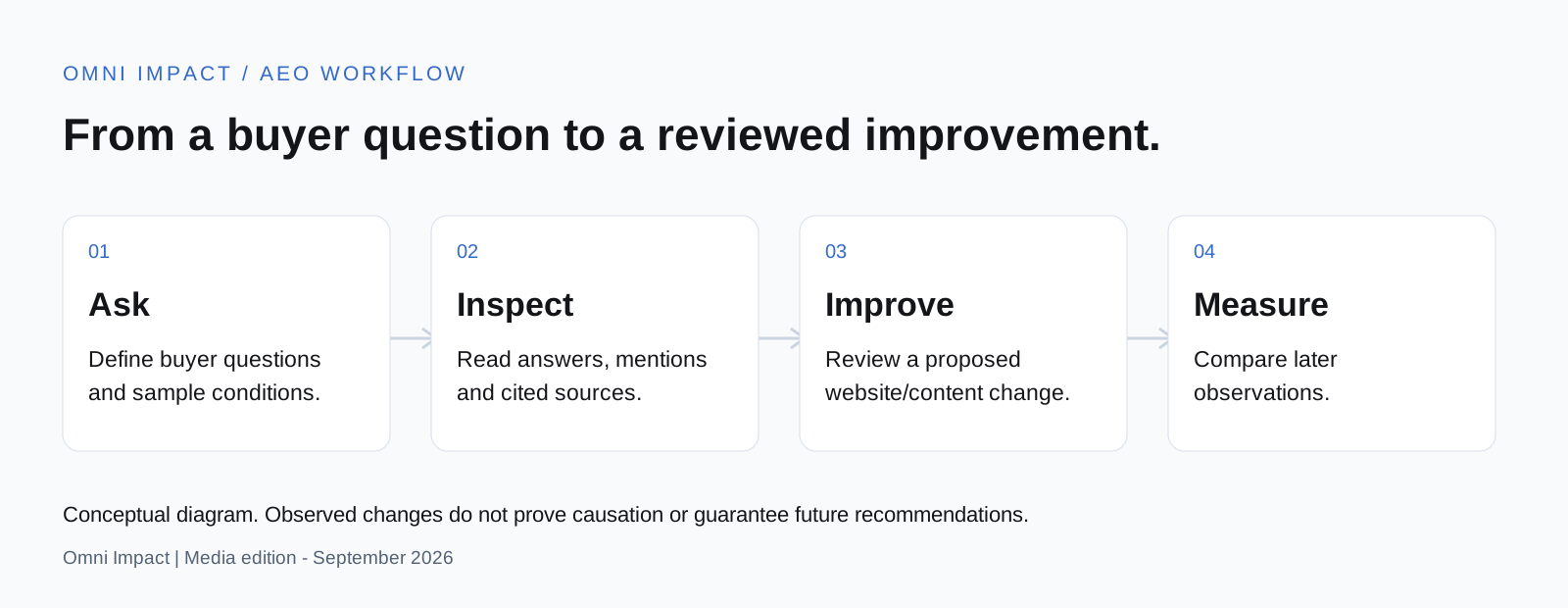
The product connects selected buyer questions, sampled answers and source inspection with reviewed website and content improvements. A mention, citation and recommendation measure different things.
- 01
Ask
Define buyer questions and sample conditions.
- 02
Inspect
Read answers, mentions and cited sources.
- 03
Improve
Review a proposed website or content change.
- 04
Measure
Compare later observations.
Official marks
Use the supplied logo intact.
SVG scales cleanly and is preferred. Transparent PNGs at 2048 px wide are there for standard publishing workflows.

One-color and symbol variants











Using the marks
- Use the full-color lockup made for the background: the light version on light surfaces, the dark version on dark ones. Black and white are the one-color alternatives.
- The symbol alone works where the company is already named.
- Do not redraw, stretch, rotate, crop or recolor the marks, or alter the gradient.
- Leave clear space of at least a quarter of the symbol’s diameter, and keep the symbol at least 20 pixels high.
- Use the supplied horizontal logo rather than setting the wordmark in a font.
Colors
- Charcoal#141519
- Cool white#F9FAFB
- Blue, on light surfaces#3269C7
- Blue, on dark surfaces#5B8FE0
Type
- Omni Impact BrandHeadings
- Omni SansBody and interface
The reporting desk
Background, evidence and questions.
Open any section for the full text. Each has an editable Markdown download. The source directory distinguishes company publications, illustrative examples and independent research.
Media edition: October 14, 2026. Company-supplied facts and public references; changing commercial details are dated below.
| Field | Detail |
|---|---|
| Company | Omni Impact |
| Legal name | Omni Impact LLC |
| Category | Answer engine optimization (AEO); AI visibility software |
| Public location | Rochester, New York, United States |
| Established | 2026 |
| Co-founders | Ben Fowler and Adam Quarterman |
| Website | omniimpact.net |
| Media contact | [email protected] |
| Business model | Subscription software for brands and agencies; enterprise options |
| Core users | Brand and marketing teams; agencies managing work for clients |
| Free starting point | AEO Readiness Check |
What it does
Omni Impact helps brands and agencies understand how they appear in AI answers, inspect the supporting sources, and turn findings into website and content improvements.
The workflow starts with relevant buyer questions and brand context. Teams inspect sampled answers, mentions, recommendations and cited sources; investigate website and content issues; review proposed changes; and compare later observations under recorded conditions.
Current public offer
On October 14, 2026, the pricing page advertised monthly launch prices of US$59 Starter, US$179 Pro and US$499 Premium. These are dated advertised rates, not a promise of permanent pricing. Billing interval, usage, supported models and workspace limits vary. Agency and enterprise packages have separate terms. See current pricing before quoting a purchase offer. The free website diagnostic is distinct from a trial of a paid plan.
Product scope
On October 14, 2026, the public pricing page said every plan checks every tracked prompt daily in ChatGPT, Google AI Overviews, Google AI Mode and Gemini. Pro adds Perplexity and Premium adds Claude; how often those two engines check a prompt depends on the plan and on which prompts a customer marks as daily prompts. Grok and an open-model pack (DeepSeek, GLM, Qwen and Kimi) are optional add-ons. Treat these as marketed coverage labels; plan access, exact provider routes and model versions vary. A recorded answer can differ from what one person sees in their own ChatGPT or Google session, which reflects that person's history and location.
Omni Impact does not control third-party AI systems. A mention is different from a citation or recommendation; a website readiness score is different from observed answer visibility. No placement, traffic, revenue or customer outcome is guaranteed.
Useful reporting hook
The company's October 3 release note describes new plans: every tracked prompt checked daily in ChatGPT, Google AI Overviews and Google AI Mode, a faster cadence on the other engines for the prompts a customer marks as daily prompts, and Grok and an open-model pack as add-ons. The public How we measure guide, published with the October 11 release, lists the engines on each plan, how often each checks and what each number means. These are company-reported capabilities; ask for a demonstration of the workflow relevant to your story.
Contact [email protected] for an interview, product demonstration, current facts or corrections. This edition includes illustrations, not customer testimonials or performance evidence.
The following descriptions are reusable company copy. They are not attributed quotations from an interview.
Short
Omni Impact helps brands and agencies understand their visibility in AI answers and turn findings into website and content improvements.
Standard
Omni Impact is an answer engine optimization (AEO) and AI visibility platform for brands and agencies. It helps teams inspect sampled AI answers, distinguish brand mentions from citations and recommendations, understand the sources behind an answer, and review practical website and content improvements. The company is based in Rochester, New York, and was founded by Ben Fowler and Adam Quarterman. Learn more at omniimpact.net.
Extended
Omni Impact helps brands and agencies investigate how AI systems describe their businesses and which sources appear in the answers. Its answer engine optimization (AEO) workflow connects monitoring with website diagnostics, content opportunities and reviewed changes. Teams can examine selected buyer questions, inspect sampled responses, look at cited sources and compare observations over time.
The platform is built around a practical distinction: being mentioned, being cited and being recommended are different outcomes. A website readiness check also measures something different from visibility in an AI answer. Omni Impact's public How we measure guide explains which AI engines it asks, how often, and what each number means. Results remain dependent on the prompts, provider routes, time window and usable observations in the sample.
Founded by Ben Fowler and Adam Quarterman, Omni Impact is based in Rochester, New York. It offers subscription plans for brands and agencies and a public AEO Readiness Check. Details are available at omniimpact.net; media inquiries can be sent to [email protected].
One-sentence category explanation
Answer engine optimization (AEO) is work intended to make a business's information easier to find, understand and accurately represent in AI-generated answers.
Names and usage
Use Omni Impact for the company/product brand, Omni Impact LLC when a legal entity name is needed, Ben Fowler and Adam Quarterman for the co-founders, and AEO after spelling out answer engine optimization on first mention. The related Omni Labs portfolio is distinct from this product. Avoid treating every portfolio project as a feature of Omni Impact AEO.
Founder biography
Ben Fowler is a co-founder of Omni Impact, which he started with Adam Quarterman. He leads product development for its AI visibility and answer engine optimization platform, connecting sampled AI answers with source analysis and practical website improvements. His work includes building software with AI coding agents.
Company background
Omni Impact LLC was established in 2026. Its public website identifies Rochester, New York, as the company's location. Omni Impact focuses on a question facing brands and agencies: what happens when a prospective buyer asks an AI system about a category, a product or a business?
The product brings together observation and action. Instead of interpreting a single answer as a complete picture, teams can work with a defined set of questions, inspect the answers and sources, assess their own pages, and review changes. Subsequent observations can then be compared with the original conditions. That process supports investigation; it does not give the company control over how independent AI services respond.
The related Omni Labs portfolio documents other software projects. Each has its own status and scope. This kit describes Omni Impact AEO, not an interchangeable bundle of all portfolio capabilities.
Interview areas
- Why brands and agencies need to separate mentions, source citations and recommendations.
- How a useful buyer-question set differs from asking only about your own brand.
- What makes a website improvement practical enough to review and implement.
- How a small software team uses AI coding agents in its development process.
- Where measurement tools should disclose uncertainty, missing data and changing model behavior.
Personal story and quotations
This kit does not supply a reconstructed personal origin story, invented founder quote or generated portrait. Ask Ben directly about his background, early decisions and the experience that led to the product. Professional information here is company-supplied; personal details should come from an attributable interview.
Facts outside this edition
Funding, revenue, valuation, ownership percentages, customer counts and customer identities are not supplied in this edition. Their absence should not be interpreted as zero, none, or a particular funding status. Biographies beyond Ben Fowler's and an approved portrait are also not included.
For an interview or additional attributable material, use [email protected]. Include the outlet, angle, deadline with time zone, and whether the request is for text, audio or video.
The practical workflow
| Step | What the team does | What it can learn |
|---|---|---|
| Set the question | Choose a brand, relevant competitors and buyer questions | Which specific discovery situations the investigation covers |
| Observe | Collect sampled responses through supported provider/model routes | What those runs returned in the recorded context |
| Inspect | Read answers, brand references, source citations and competitor context | Where an answer gets information and how a brand is represented |
| Diagnose | Review website accessibility, information clarity and content gaps | Candidate improvements to pages and supporting content |
| Review and act | Check generated proposals and use an available delivery path | What will change, where, and under whose approval |
| Re-measure | Compare later observations with their sample conditions | Whether the observed pattern changed; causality requires more evidence |
Capabilities and boundaries
Monitoring. Track chosen prompts and investigate answers over time. Sampling coverage and frequency depend on the account, plan and supported routes. Brand discovery, comparison and branded queries answer different questions and should be described separately.
Source inspection. Inspect citations and the domains supporting an answer. A frequently cited source is not automatically accurate, independent, endorsed or causally responsible for a recommendation.
Website diagnostics. A crawl can reveal access, structure and information issues in the pages it reaches. An unsuccessful crawl is an observed retrieval problem; it does not establish that every AI service is unable to access a site. Diagnostic criteria are not universal ranking rules.
Recommendations and content. Findings can inform proposals for website or content changes. Generated claims and code need review against the actual business and site. An automatically generated suggestion is not proof of factual correctness or expected commercial impact.
Delivery. The public product describes connected website/CMS workflows, GitHub review paths and manually applying exported changes. Availability and action type depend on the integration and permissions. A message/task destination is not equivalent to publishing a web page. Verify the particular path before demonstrating it.
Agency work. Agencies can organize work around client brands and workspaces. Do not infer that a whole portfolio is one comparable sample; record the brand, workspace and question set behind each result.
Free diagnostic. The AEO Readiness Check is a public entry point for website investigation. It is not a live survey of all consumer AI applications, and a high score does not guarantee that an answer will mention or cite a business.
What the numbers mean
The public How we measure guide, updated October 11, 2026, lists the engines on each plan, how often each checks and what each dashboard number means. It replaced the earlier in-app Methodology page. A deeper walkthrough of the method is available from the company on request.
| Term | Plain-language meaning | Reporting caution |
|---|---|---|
| Mention rate | The share of recorded answers that name the brand | Name detection and the counted answers matter |
| Citation rate | The share of recorded answers that cite the brand's site or the brand | A link is not the same as a positive recommendation |
| Share of voice | The brand's share of all brand mentions in answers to category questions that do not name it, including brands it does not track; a recommendation counts for more than a passing mention | Changing the question set or counting rule changes the result |
| Scores | Indexes from 0 to 100, such as the Website, Prompt and Overall scores; not percentages of answers | A rate and a score can move differently |
| Recommendation | An answer actually selects or endorses an option | A passing or negative mention does not establish it |
| Readiness score | A diagnostic of the site properties checked | It is not an answer-visibility measurement |
Illustrative arithmetic: if a brand appears in 3 of 12 eligible sampled answers, its mention occurrence rate for that sample is 25%. That does not mean 25% of people see the brand. The example is invented for explanation and is not an Omni Impact or customer result.
Conditions needed for a publishable result
Record the prompt set; branded versus unbranded context; provider route and model/version; execution surface; dates; usable sample size; exclusions and failures; brand-detection rules; metric definition and denominator; competitor set; and any weighting or uncertainty method. Keep the underlying answers or a privacy-safe evidence extract available for fact-checking.
A confidence interval describes uncertainty under its assumptions. It does not remove prompt-selection bias, personalization differences, model changes or dependent observations. Repeated responses can be correlated. “No usable observations” is different from zero visibility.
Comparing tools
Comparing two tools fairly means aligning their time windows, questions and engines. A comparison needs answer-level records, not just rows of citations or a screenshot of a score. Explain unmatched models, excluded rows and differences in prompt mix. A remaining gap is not automatically proof that either tool is inaccurate. No named competitor ranking or superiority claim is provided here.
What the product does not establish
It cannot guarantee recommendations or reproduce every user's personalized consumer-app experience. It cannot infer customers, traffic, purchases or revenue from an answer count alone. A before/after observation does not prove that a particular edit caused a change. Training a foundation model, purchasing placement inside answers, and operating the third-party answer engines are outside the product description in this kit.
What problem is Omni Impact trying to solve?
Brands need to understand how AI answers describe them and what information those answers rely on. Omni Impact connects that investigation with practical website and content work.
Who is it for?
Brand and marketing teams, and agencies doing this work for clients. Those are intended audiences, not a claim about the composition or size of the customer base.
Is AEO a replacement for SEO?
It is an additional way to frame discovery and measurement. Useful, accessible, accurate website content still matters. The kit's external context includes Google's own guidance, which should be considered alongside vendor claims.
What is different about the product's approach?
Its stated emphasis is connecting sampled answers and sources to diagnostics, reviewed changes and subsequent measurement. This is a description of the intended workflow, not an independently tested claim of uniqueness or superiority.
Can the company make an AI system recommend a brand?
No guaranteed placement is offered in this kit. Independent providers determine their own answers. A business can improve its information and observe responses; it does not gain control of those systems.
Does a citation mean a recommendation?
No. An answer can link to a source without endorsing its business. It can mention a brand negatively, mention competitors alongside it, or recommend something without a directly corresponding citation.
Are these the exact answers a customer sees in ChatGPT or another app?
Do not assume that. A provider route, model version, search setting, time, geography and a user's personal context can all matter. Describe the actual sampled execution surface rather than equating it with every consumer experience.
Which models are covered?
On October 14, 2026, the public pricing page said every plan checks every tracked prompt daily in ChatGPT, Google AI Overviews, Google AI Mode and Gemini. Pro adds Perplexity and Premium adds Claude. Grok (from Pro) and an open-model pack of DeepSeek, GLM, Qwen and Kimi are add-ons. Access, check frequency, precise versions and routes vary by plan and configuration. Reconfirm coverage for the planned demonstration.
Does it monitor Google AI Overviews or Microsoft Copilot?
Google AI Overviews and Google AI Mode are on the public coverage list for every plan. The company reports checking every tracked prompt in both surfaces daily since its October 3 release, which said the change would roll out to every workspace over the following days; this is company-reported, not independently verified. Microsoft Copilot is not on the public coverage list. Do not infer Copilot monitoring from general optimization advice or a category name. Ask the company for a current, surface-specific demonstration before reporting support.
What does the free readiness score mean?
It summarizes the website properties the diagnostic checks. It is not proof of inclusion in AI answers, a provider certification or a forecast of customer acquisition.
Will adding structured data or llms.txt guarantee visibility?
No. Any suggestion should fit the website, be accurate and be evaluated against the relevant platform's current guidance. There is no universal file or markup change that guarantees a citation or recommendation.
Does a proposed fix automatically change a website?
The public workflow describes explicit publishing actions and review paths. The available action depends on the connection and permission. Ask to see approval, delivery and change history for the specific path; do not assume every integration publishes or supports the same reversal behavior.
What is new?
The company-reported October 3 release introduced new plans: every tracked prompt checked daily in ChatGPT, Google AI Overviews and Google AI Mode, daily prompts with a faster cadence on other engines, and Grok and open-model add-ons. Other October notes describe product documentation, AI search volume estimates, a Share of Voice redesign, guided setup, a Google Analytics 4 Outcomes view and a public How we measure guide that replaced the in-app Methodology page. The October 4 release lets a customer open the AI answer behind each counted run, and leads the dashboard with questions that do not name the brand. See the dated public release notes rather than treating a historic kit as the latest release forever.
How much does it cost?
The October 14 pricing snapshot lists monthly launch prices of US$59, US$179 and US$499 for Starter, Pro and Premium. Agency and enterprise options have separate conditions. Verify the current pricing page, billing interval and included usage before publishing. The public readiness check is free; that does not mean a free trial of every paid feature.
What about Agent Journeys and other features advertised elsewhere?
This kit concentrates on the core measurement-to-action workflow. For an additional module, request a current demonstration and the applicable plan/availability details. A marketing page or a release-note entry alone should not be treated as verification of a particular account's access.
Is there evidence of improved revenue, traffic or customer results?
This edition supplies no customer case study or independently validated commercial outcome. Its interface illustrations use demo data. An evaluation would need an agreed method, underlying evidence and permission to publish any customer material.
How are privacy and security handled?
Consult the current published privacy policy and terms, and request a written explanation for the intended use. This kit does not assert a certification, universal data-residency promise, zero retention, or a guarantee about every external provider's handling of data. Do not use confidential customer information in an unsanctioned demonstration.
Is Omni Impact affiliated with the AI providers it names?
Provider and product names describe coverage or context. They do not imply investment, certification, partnership, sponsorship or endorsement.
Who founded it, and where is it based?
Ben Fowler and Adam Quarterman founded Omni Impact. The company website lists Rochester, New York. See the founder background for the professional biography included in this edition.
Are funding, revenue or customer counts public in this kit?
They are not supplied. Do not infer a number or funding status from that omission. Direct factual questions to the media contact.
Can I quote Ben from this package?
The descriptions and background text are company-supplied copy, not verbatim remarks by Ben. Request an attributable interview or written statement before putting words in quotation marks under his name.
Where can I get images, a demo or a correction?
Logos, three captioned public-site screenshots and an explanatory diagram are included. For an interview, a live product walkthrough, additional materials or a correction, email [email protected] with your outlet and deadline.
These are reporting directions, not claims that a funding event, partnership or new launch has occurred. Reporters remain free to test the premise and interview independent sources.
1. What does an AI visibility score actually count?
Angle: A single score can hide several different measurements. Omni Impact's public How we measure guide gives a concrete starting point for examining mention rate, citation rate and share of voice.
Questions: What is the denominator? What happens when a model fails? How are duplicates and branded questions treated? Why might two tools disagree? What uncertainty remains after aligning their inputs?
Evidence to request: A privacy-safe answer-level export, the prompt list, metric definitions and a comparison with recorded exclusions. The public release note is a lead for investigation, not independent proof of accuracy.
2. The agency workflow after the AI-answer screenshot
Angle: An agency's work does not end with showing a client a model response. Explore the handoff from evidence to an actual website improvement.
Questions: Which finding is actionable? Who approves the wording? What goes to a CMS, what becomes a pull request, and what remains manual? How is the change recorded and checked later?
Evidence to request: One end-to-end demonstration using a permitted demo site, with the proposed change and the observed outcome kept separate.
3. A small Rochester software company working with AI agents
Angle: A local founder building an AI-related product while also using coding agents in the development process.
Questions: What does Ben still decide himself? How are generated changes reviewed? Where do agents save effort, and where do they create rework? What was the actual origin of the company?
Evidence to request: An attributable founder interview and a demonstration of a non-sensitive development workflow. This kit supplies no headcount productivity multiplier or invented personal anecdote.
4. A website can be readable without being recommended
Angle: Explain the gap between technical readiness, information quality and what an AI system ultimately says.
Questions: What does a crawl prove? What does it fail to prove? Can a highly readable site still be absent from an answer? Why might a brand be mentioned without its website being cited?
Evidence to request: A defined diagnostic, a separate answer sample, and an independent search or information-retrieval specialist's interpretation.
5. The sources behind the answer
Angle: Brand teams may discover that other sites describe their business more often than their own pages do. Reporting can examine how teams inspect those sources without treating every citation as trustworthy.
Questions: Are the sources current? Do they agree? Can the underlying claim be verified? Is the source a review, the company's own page or another kind of evidence?
Evidence to request: A small set of attributable, publicly accessible answers and the pages they actually cited, recorded with date and execution context.
6. What responsible AEO should avoid promising
Angle: Distinguish useful measurement and website work from claims of guaranteed AI placement.
Questions: What would falsify an optimization claim? When is a before/after chart misleading? Which platform guidance contradicts a proposed tactic? Can a vendor explain missing data without turning it into zero?
Evidence to request: The external context sources, a vendor demonstration and a skeptical independent perspective. No competitor allegations are supplied by this kit.
A practical 20-minute interview
- Minutes 0-3: Ask Ben to describe the company and the original problem in his own words.
- Minutes 3-8: Follow one buyer question through an answer, mention/citation distinction and source inspection.
- Minutes 8-12: Examine one website/content finding and its proposed change.
- Minutes 12-16: Ask what a score, comparison and confidence interval do and do not establish.
- Minutes 16-19: Discuss the business model, intended users and Ben's development process.
- Minute 19-20: Confirm spellings, facts, attribution, image captions and any promised follow-up evidence.
Optional recording shots
- Founder speaking to camera, with name and role confirmed in the actual recording.
- A clean demo workspace showing the question, sample conditions and one answer.
- A source page beside the answer that cited it.
- A proposed content/code change before approval.
- The answer behind a counted number, with its engine, date and question visible.
The included screenshots are suitable as labeled illustrations. They are not video footage or an independently observed customer session. Arrange recordings through [email protected].
A five-minute public orientation
0:00-0:45 - The question. Open omniimpact.net. Explain that the product investigates how a brand appears in sampled AI answers and connects findings to website work. The public Paxora scenes are illustrative: Paxora (paxora.example) is a fictional accounts-payable automation brand, not a customer account.
0:45-1:45 - Read the answer before the score. Open Monitoring. Discuss mentions, recommendations and citations separately. Ask what prompt, provider route and time window produced a number.
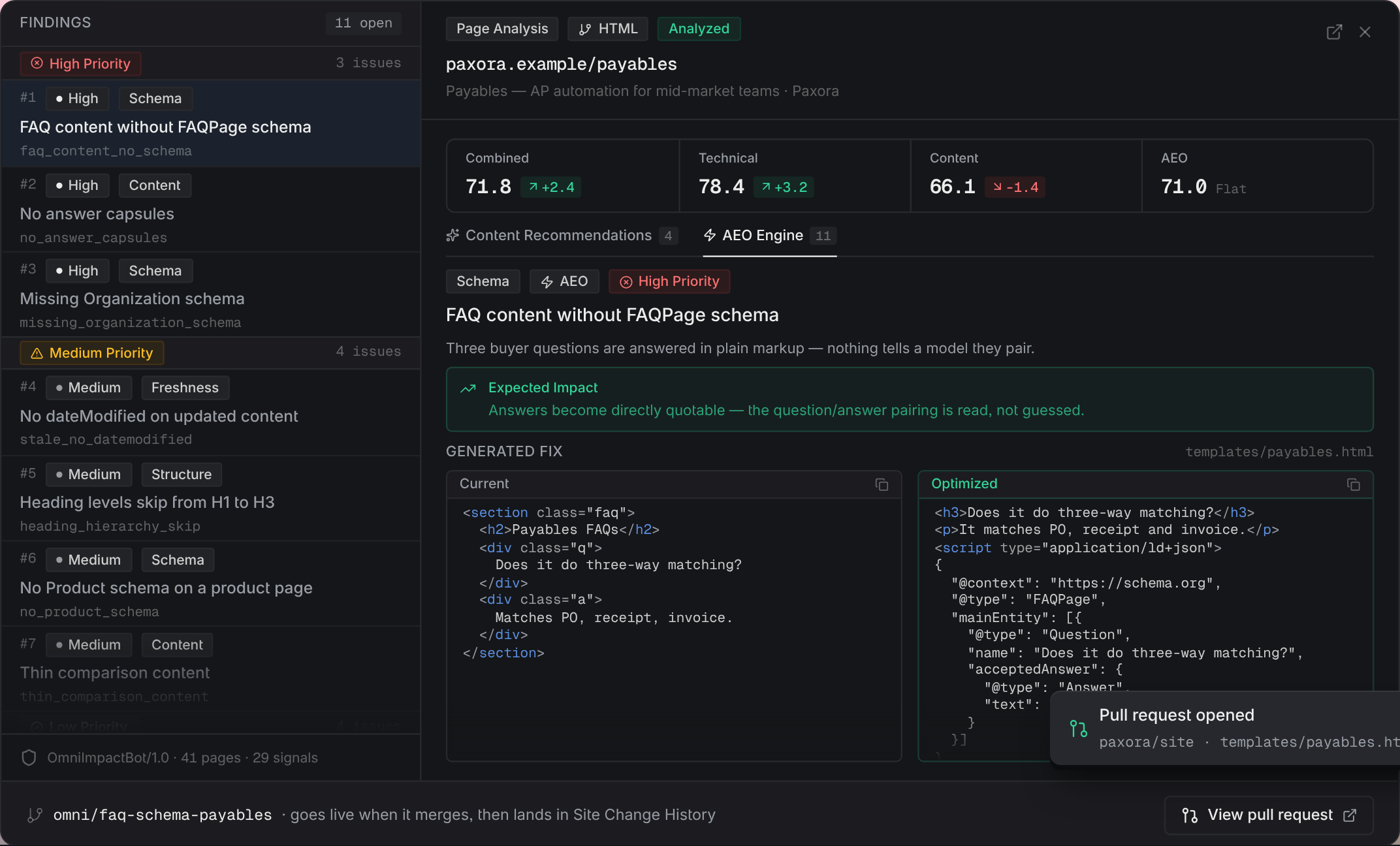
1:45-2:45 - Inspect the proposed change. Open Recommendations. The interface illustration shows a finding and a candidate fix. Explain the need to check factual content, applicability, permissions and the exact delivery path. The animation does not demonstrate a production write.
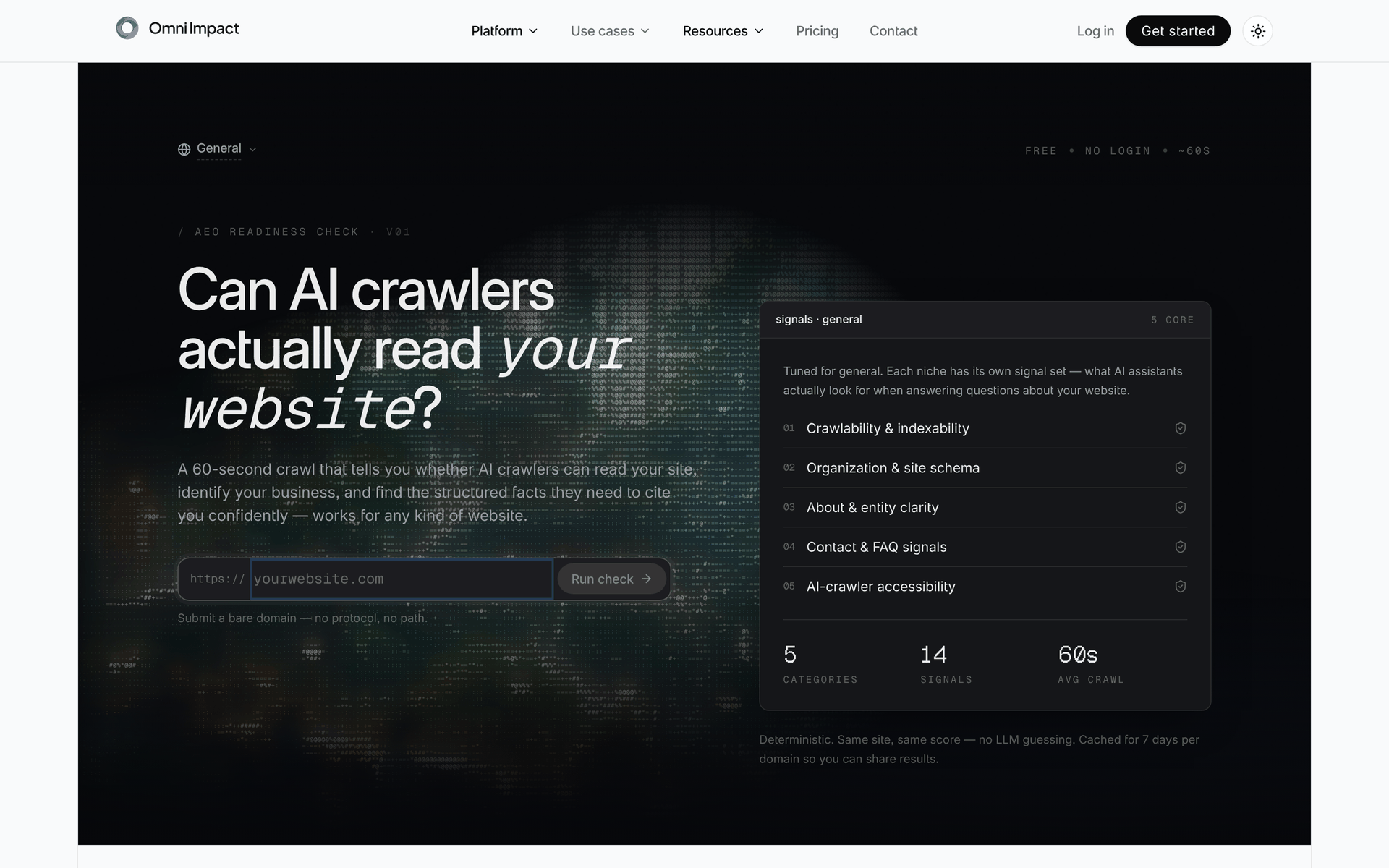
2:45-3:30 - Separate readiness from visibility. Open the free readiness page. Its entry screen shows the diagnostic concept. If running a scan, use a site you may test, record the conditions and show the actual returned result. This kit does not include a newly run scan.
3:30-4:30 - Look at methodology. Read the public How we measure guide. Ask for a current account demonstration that opens the answers behind a number and shows its denominator and excluded rows. Public notes describe the product; they do not substitute for that demonstration.
4:30-5:00 - Close with the limits. State that responses vary, a recorded answer can differ from one person's own session, and improvements do not guarantee placement or revenue. Point to the current pricing and media contact.
For a live account demonstration
Arrange access with the company; this package does not grant a paid account, press trial or production permissions. Use a dedicated demo workspace and data cleared for the recording. Keep browser profiles, private workspaces, billing screens, tokens, account email addresses and unrelated tabs off camera.
Ask to see the actual run context, a raw answer, source evidence, a proposed edit, its review/delivery path, and a subsequent measurement with its limitations. Do not execute a publication to a real customer site merely to complete a demo. A prepared example can explain the workflow if it is labeled accordingly.
Captions are part of the evidence
The image guide provides required context and credits. Paxora, its paxora.example address and account, scores, competitor names and changes belong to the illustrative website scenario. They are not verified customer identities, testimonials or results. The readiness screenshot is an unsubmitted public entry screen, not an audit result.
The following dates refer to entries in the public product changelog, checked October 14, 2026. They are company-reported product milestones, not independently audited deployment dates or legal formation dates. Historical capabilities are not a promise of current access in every account.
| Published date | Selected milestone | Source |
|---|---|---|
| February 7, 2026 | Initial launch entry: dashboard, agent, prompt tracking and domain management | Release note |
| May 31, 2026 | Self-serve checkout and public AEO Readiness Check | Release note |
| June 30, 2026 | Guided onboarding and refinements to Share of Voice | Release note |
| July 31, 2026 | GitHub/WordPress publishing, change history and fix-measurement work | Release note |
| August 20, 2026 | Provider web-search routes, recorded citations and prompt-tracking updates | Release note |
| September 11, 2026 | Content editing and dated chart annotations | Release note |
| September 24, 2026 | Methodology explanations, compatible export comparisons and prompt imports | Release note |
| October 1, 2026 | Product documentation: public guides to workspace setup, AEO measurements and integrations | Release note |
| October 3, 2026 | New plans: every tracked prompt checked daily in ChatGPT, Google AI Overviews and Google AI Mode; daily prompts; Grok and open-model add-ons | Release note |
| October 4, 2026 | Answer receipts for each counted run, unbranded questions first and team controls | Release note |
| October 9, 2026 | AI search volume estimates for tracked prompts, questions people ask AI and a Share of Voice redesign | Release note |
| October 11, 2026 | Guided setup ending on a first AEO brief, a page for every prompt, Google Analytics 4 Outcomes and a public How we measure guide | Release note |
The release history provides a route for further reporting. The kit does not claim a new launch on its own publication date, and it does not announce fundraising, partnerships or a customer win.
A conceptual system overview
Omni Impact is a web-based software product. A user defines the brand and questions to investigate. The service works through supported AI provider/model routes and records observations for analysis. Website crawling and content diagnostics supply a separate type of evidence. Results and proposals are presented in the application; an available connection or export can support a reviewed change.
This is a conceptual explanation, not a disclosure of internal infrastructure, service identifiers or a guarantee that every configured route is enabled. Hosting and database vendor names alone would not explain what an answer measurement means.
What inputs and outputs matter to a story
| Input or context | Possible output | Interpretation |
|---|---|---|
| Brand/domain and selected questions | Sampled model answers | Observations for those conditions |
| Brand and competitor definitions | Mentions and comparison metrics | Dependent on detection and comparison rules |
| Sources returned with answers | Citation/source analysis | Attribution in the sample, not proof of endorsement |
| Retrieved website content | Diagnostics and candidate improvements | Findings about the reached content and chosen checks |
| Reviewed proposed change | An available publish/review/export action | Connection-specific action, not a universal integration promise |
| Later answer samples | Trends or comparisons | Descriptive unless supported by a causal research design |
Commercial model
Omni Impact markets recurring software subscriptions with tiered usage and model access. Brand plans, agency packaging and enterprise options are described on the current pricing page. The free readiness tool is a separate entry point. A price shown in this edition is a dated offer snapshot, not a claim about contract value, revenue or customer adoption.
Data handling questions worth asking
Read the privacy policy and terms for the current published position. Ask which data is needed for the particular workflow, which providers receive it, how long it is kept, and what access or deletion options apply. Route contractual or provider-specific questions to the company for a current written answer.
No compliance certification, security audit conclusion, universal retention period, regional hosting guarantee or blanket training-data assertion is made in this package. Policy text is a company statement, not independent proof of every operational control.
Relationships and attribution
AI provider, website platform and integration names describe technical context. They do not imply a partnership, paid endorsement, investment or certification. The company does not own or operate the third-party answer engines whose outputs may be examined.
Evaluating the product
Use comparable question sets and explicitly recorded conditions. Inspect raw answers as well as charts. Test a specific supported delivery path with permitted data. Evaluate whether the work helped answer a business question or produce a useful change, without treating that alone as proof of downstream revenue.
Supplied assets
This package supplies original Omni Impact logo variants, three public-site screenshots, an explanatory workflow diagram, and two PDF documents. Use the asset manifest for exact paths, dimensions, hashes, captions, credits and evidence status. This edition includes no founder portrait, customer photograph, testimonial or video master.
Assets are supplied for editorial coverage of Omni Impact. Preserve context, avoid implying endorsement, and use the supplied marks intact. Third-party names and marks visible in an interface retain their owners' rights. Font files retain the bundled SIL Open Font License notices.
Logo selection
Use the horizontal gradient-light lockup on a light background and gradient-dark on a dark background. The black and white variants are the supplied one-color alternatives. The symbol alone works where the company is already named. SVG is preferred for scaling; transparent PNGs are provided for standard publishing workflows.
Do not redraw, stretch, rotate, crop, recolor or alter the gradient. Leave clear space of at least one quarter of the symbol diameter. Keep the symbol at least 20 CSS pixels high. Use the provided horizontal logo rather than trying to recreate the wordmark with a font.
Visual reference
| Role | Value |
|---|---|
| Charcoal | #141519 |
| Cool white | #F9FAFB |
| Light-surface blue | #3269C7 |
| Dark-surface blue | #5B8FE0 |
| Headings | Omni Impact Brand, typically Medium/Semibold |
| Body and interface type (website and product) | Omni Sans, since October 2026 |
The PDFs and offline page in this package are typeset in Omni Grotesk, the earlier supporting face, whose files and license travel with the package.
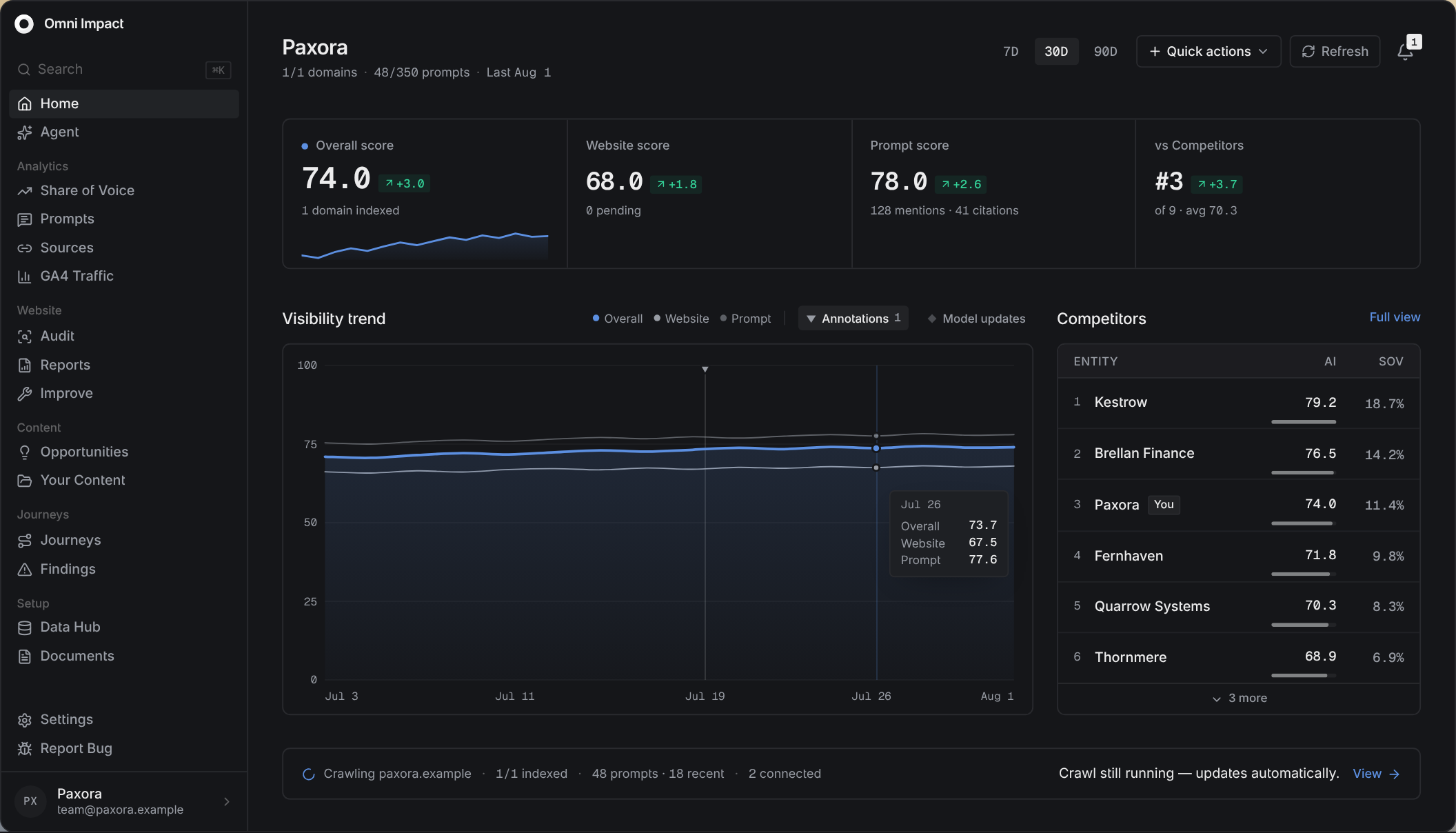
Image 1 - Dashboard illustration
File: assets/screenshots/01-dashboard-illustrative.png
Caption: Omni Impact's public homepage illustrates its dashboard using a Paxora demo scenario, a fictional accounts-payable automation brand. All displayed scores, trends, brands and account details are illustrative; this is not a customer result. Captured October 14, 2026.
Alt text: Dark Omni Impact dashboard illustration with visibility summaries, a trend chart and competitor comparisons for the Paxora demo scenario.
Source: Public homepage. Credit: Courtesy of Omni Impact.
Image 2 - Website findings illustration
File: assets/screenshots/02-findings-illustrative.png
Caption: An Omni Impact interface illustration on the public Recommendations page shows website findings and a proposed fix in the Paxora demo scenario. Displayed scores, issues, expected effects and the pull-request notice are illustrative; they do not record a change to a real site, establish a customer outcome or guarantee that a suggested tactic improves AI visibility. Captured October 14, 2026.
Alt text: An illustrative page-analysis view for the Paxora demo scenario lists website issues beside a selected finding, current and optimized code for a proposed fix, and a pull-request notice.
Source: Recommendations page. Credit: Courtesy of Omni Impact.
Image 3 - Public readiness entry screen
File: assets/screenshots/03-readiness-public.png
Caption: The public Omni Impact AEO Readiness Check entry page, captured October 14, 2026. No domain was submitted for this image. A website diagnostic is distinct from a measurement of actual mentions or citations in AI answers.
Alt text: The public AEO Readiness Check page with an empty domain field and a list of diagnostic categories.
Source: Readiness Check. Credit: Courtesy of Omni Impact.
Image 4 - Workflow diagram
File: assets/diagrams/measurement-to-action.svg
Caption: Conceptual Omni Impact workflow: define questions, inspect sampled answers and sources, review improvements, then compare later observations. Diagram; not a screenshot or performance result.
Alt text: Four connected stages labeled Ask, Inspect, Improve and Measure, with a note that observed changes do not prove causation.
Credit: Omni Impact.
Reuse and accessibility
Keep the illustrative/demo qualification with any screenshot, including social crops and broadcast graphics. Preserve image aspect ratios; do not enlarge small text beyond legibility or present a screenshot date as a measurement period. Use alt text and meaningful captions. The offline media page and text files provide accessible explanations alongside visual documents.
External context
Google's current Search Central guide says established SEO practices remain relevant to its generative search features. Its guidance is specific to Google; it does not certify Omni Impact or promise placement. Google Search Central
Pew's July 2025 analysis of 900 US adults' March browsing found traditional-result clicks on 8% of Google visits with an AI summary versus 15% without. Results were collected in April. This observational, historical study is neither a causal test nor an Omni Impact outcome. Pew Research Center
These sources help frame reporting questions. They do not establish the size of Omni Impact's market, a current industry-wide click rate, customer demand, or a promised return on investment. Independently interview researchers, agencies and business owners before drawing those conclusions.
Evidence levels in this edition
- Company-supplied: identity, founders and roles, establishment year, descriptions and professional background.
- Publicly observable: the website, listed business contact, public tool entry screen and advertised offer on the check date.
- Company-reported release: descriptions of capability in the public changelog, not a fresh account-level verification.
- Illustrative: public marketing interface scenes and the explanatory arithmetic example.
- Independent context: the linked Google guidance and Pew research, each within its stated scope.
No external study in this kit validates an Omni Impact customer result. No source link implies endorsement. Pricing and access should be refreshed at publication; retain dates when citing a historical release or study.
Source directory
S01 - Omni Impact - public product website
Omni Impact - public product website
Type: Company publication. Checked 2026-10-14. Positioning, advertised model families, public location and business contact. Marketing illustrations are synthetic.
S02 - AI search monitoring
Type: Company publication. Checked 2026-10-14. Monitoring workflow and public interface illustration; not an independent product benchmark.
S03 - Recommendations and delivery options
Recommendations and delivery options
Type: Company publication. Checked 2026-10-14. Audit, generated proposals and delivery paths. Particular actions depend on connection, permissions and availability.
S04 - Pricing and plan details
Type: Current advertised offer. Checked 2026-10-14. Prices and plan conditions can change. Verify the live page and checkout before reporting an offer.
S05 - Free AEO Readiness Check
Type: Public tool entry page. Checked 2026-10-14. Website diagnostic. This kit does not present a newly executed scan or an AI-answer coverage result.
S06 - Methodology, Compare & Prompt Import - September 24, 2026
Methodology, Compare & Prompt Import - September 24, 2026
Type: Company release note. Checked 2026-10-14. Company-reported release; not a fresh test of every paid account or entitlement.
S07 - Public release history
Type: Company release history. Checked 2026-10-14. Product milestones as described by the company. Not a corporate filing record.
S08 - Media and general contact
Type: Company contact. Checked 2026-10-14. Public business inquiry route. Email is [email protected] as displayed in the website footer.
S09 - Privacy policy
Type: Published company policy. Checked 2026-10-14. Company policy statement, not an independent certification. Read the current policy for applicable data practices.
S10 - Terms of service
Type: Company legal reference. Checked 2026-10-14. Linked from the live site; consult the current document for terms. No legal conclusion is provided by this kit.
S11 - Google Search Central: optimizing for generative AI search
Google Search Central: optimizing for generative AI search
Type: Independent platform documentation. Checked 2026-09-26. Google Search guidance; not guidance for every provider and not an endorsement of Omni Impact.
S12 - Pew Research Center: Google clicks and AI summaries
Pew Research Center: Google clicks and AI summaries
Type: Independent observational research. Checked 2026-09-26. 900 US adults; March 2025 browsing, search results collected April 7-17, 2025. Historical Google-only analysis, not a causal product study.
S13 - Omni Labs public portfolio
Type: Company portfolio. Checked 2026-09-26. Related software work. Portfolio projects have separate maturity and availability; do not combine their features with Omni Impact AEO.
S14 - New Plans: Engines, Daily Prompts & Add-ons - October 3, 2026
New Plans: Engines, Daily Prompts & Add-ons - October 3, 2026
Type: Company release note. Checked 2026-10-14. Company-reported release on plan coverage, daily checks and add-ons; not a fresh test of every paid account or entitlement.
S15 - How we measure
Type: Company documentation. Checked 2026-10-14. Company description of the engines on each plan, check frequency and what each dashboard number means; not an independent audit of the method.
S16 - Guided Setup, Prompt Pages & GA4 Outcomes - October 11, 2026
Guided Setup, Prompt Pages & GA4 Outcomes - October 11, 2026
Type: Company release note. Checked 2026-10-14. Company-reported release, including the How we measure guide replacing the in-app Methodology page; not a fresh test of every paid account or entitlement.
Media inquiries: [email protected]
Website: omniimpact.net · Contact page: omniimpact.net/contact
Request an interview with co-founder Ben Fowler, a product demonstration, an explanation of a metric, current commercial facts, additional image material or a factual correction.
To help route the request, include your outlet, name, story angle, deadline with time zone, requested format and the specific facts or visuals you need. A request does not automatically establish interview availability, a response deadline, an embargo, an exclusive, an account entitlement or a promised quotation. Arrange those directly.
Fact-checking and corrections
Include the sentence, number or image in question, its source and the proposed publication date. The company can provide factual clarification and source material. Editorial decisions remain with the outlet. Keep the publication date and methodology next to any measurement; do not treat a company response as independent validation.
Official public routes
- Company website
- X profile linked from the company website
- LinkedIn page linked from the company website
- Public GitHub organization linked from the company website
- Public product changelog
Social and organization links above were checked as outbound links on the company website; this edition does not certify third-party account badges or current follower totals. The public routes above are different from the team's internal knowledge repository.
Images for coverage
Product views, with their context.
These are public-site illustrations, an unsubmitted diagnostic entry screen and a conceptual workflow diagram. Keep the captions with the images; none is a customer result.
Workflow diagram
Conceptual workflow, not a screenshot or measured result.
Download SVG2 KBDashboard illustration
Omni Impact public homepage dashboard illustration using Paxora demo data (a fictional brand). Scores, trends, brands and account details are not customer evidence.
Download PNG2112 × 1208 · 235 KBFindings illustration
Omni Impact Recommendations page illustration of website findings and a proposed fix, using Paxora demo data. Displayed effects and the pull-request notice are not verified outcomes, real site changes or guaranteed improvements.
Download PNG2144 × 1296 · 374 KBReadiness Check entry page
Unsubmitted public AEO Readiness Check entry screen. No scan performed for this image; readiness is distinct from answer visibility.
Download PNG1920 × 1200 · 498 KB
Interviews · demonstrations · corrections
Let’s make the facts easy to find.
Include your outlet, angle, deadline with time zone and requested format. Ask for an interview, a demonstration of the workflow relevant to your story, a fact check or a correction.
Omni Impact · Media edition October 14, 2026. Pricing and access can change. No customer results, attributed founder quotations or portrait photographs are supplied in this edition.